// How to Look After a Vinyl Wrap
A well-fitted vinyl wrap is tough, but it is still a film sitting on your paint. How you wash it, what you put on it and how quickly you deal with bird droppings or road salt all affect how it looks in a year or two.
This is the aftercare we talk through when you collect a wrap from our Knaresborough studio. A good-quality wrap, fitted properly and looked after, should look great for up to 5 years, and ours come with a 3-year warranty.
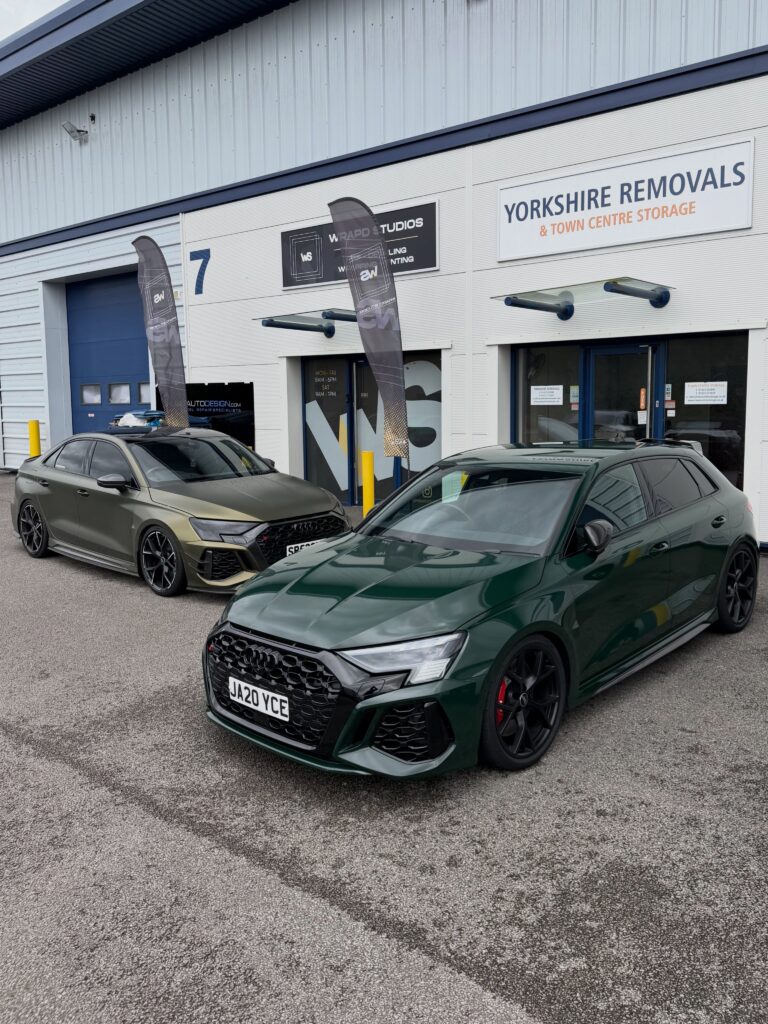
You can see this kind of gloss colour-change on our Audi RS3 in British Racing Green.
The first week after fitting
The adhesive needs a little time to settle, especially around edges, recesses and seams.
Leave the car about a week before the first wash. In that first week:
- Drive it normally, but be gentle around the edges if you are wiping anything off.
- Avoid automatic car washes and pressure washers.
- If you pick up bird droppings, bugs or a fuel splash, dab them off with a soft, wet microfibre. Do not scrub, and do not use strong solvents.
- Try not to park under trees, where sap and birds can mark fresh film.
- Do not pick at any edge, even if it looks slightly proud. If something worries you, get in touch.
When you collect the car we will talk you through aftercare for your film and finish.
How to wash a wrapped car
Hand washing is the safest method. Automatic brush washes can scratch film and catch edges, so skip them.
- Rinse first to lift grit, especially along the sills, lower doors and behind the wheels.
- Use the two-bucket method: one bucket for a pH-neutral, wrap-safe shampoo, and one with clean water to rinse your mitt.
- Wash with a clean, soft mitt, working from the roof down. Let the shampoo do the work rather than leaning on the film.
- Rinse thoroughly, including door shuts if you can reach them without catching an edge.
- Dry with a soft, clean microfibre. Pat or use gentle strokes. A dirty towel dragged across the film is what leaves swirls.
Wash often enough that dirt does not bake on. In a Yorkshire winter, that usually means more often, not less. For a fuller method covering PPF and ceramic too, see how to wash a wrapped, PPF or ceramic-coated car.
Products to use — and what to avoid
Use: a pH-neutral shampoo described as safe for vinyl wraps, soft mitts and clean microfibres. On a gloss wrap, a wrap-safe detailer or sealant can help the finish stay fresh. If you have a ceramic coating over the wrap, stick to coating-safe products.
Avoid: automatic brush washes; household detergents and washing-up liquid; abrasive polishes, cutting compounds and harsh solvents; ice scrapers, credit cards or fingernails on the film; and any product that promises a “cut” or “restoration” unless we have said it is suitable.
Matt and satin wraps need extra care. Never wax or polish them — those products can leave shiny, patchy marks. Use products made for matt or satin film instead. There is a separate guide to looking after matt and satin wraps.
We do not tie aftercare to one brand. A reputable wrap-safe, pH-neutral shampoo is fine.
Pressure washers: distance and angle
A pressure washer is useful for rinsing grit, but it is the easiest way to lift an edge if you get too close.
- Keep the lance at least a metre from the panel.
- Hold the jet at a shallow angle, not square-on to an edge or seam.
- Never aim into gaps, badge edges, mirror caps, arch liners or anywhere the film has been tucked.
- Use a fan jet, not a narrow pencil jet. A hose is even gentler in the first weeks.
If an edge lifts, stop washing that area and contact us. Do not try to stick it down yourself.
Bird droppings, bug splatter and fuel spills
These are the marks that stain a wrap if you leave them, especially in the sun.
- Bird droppings are acidic. Soak them with a wet microfibre or a wrap-safe detailer, then lift them away. Do not grind them off dry.
- Bug splatter on the bumper and bonnet should be soaked and wiped, not scraped.
- Tree sap and leaf staining need a patient soak. Avoid solvent-heavy removers unless they are wrap-safe.
- Fuel spills at the filler can soften vinyl if they sit. Wipe immediately, then wash with pH-neutral shampoo. If fuel has run into an edge, tell us.
A couple of clean microfibres in the boot save a lot of bother on a sunny day.
Winter salt and Yorkshire weather
British sun is kinder to vinyl than heat in hotter countries, but our winters are hard on film. Road salt and grit from the lanes around Harrogate, Nidderdale and the Dales cling to the lower body.
- Rinse salt off regularly, especially along the sills, lower doors, rear bumper and wheel arches.
- Never use an ice scraper on wrapped panels. Use a de-icer on the glass and let ice on the body thaw. Rinse off any runoff when you can.
- Do not pour boiling water over a frozen car.
- A garage or carport helps. If you use a cover, choose a soft, breathable one and only put it over a clean, dry car.
There is a fuller seasonal guide in how to protect a wrapped or PPF car through a Yorkshire winter. Our earlier post on how wraps cope with winter weather is useful background.
When to come back for a check
Get in touch if an edge starts to lift, a corner looks dry or proud, staining will not wash out, or the film is damaged in a scrape. Small areas can often be repaired by re-wrapping a single panel, as long as the same film is still available.
If you are planning to sell the car, hand back a lease or change colour, book professional removal while the wrap still comes away cleanly. Waiting until the film is brittle makes the job harder. There is more in how long a car wrap lasts in the UK and removing vinyl wrap.
We offer a free check 30 to 90 days after fitting. Get in touch sooner if something looks wrong.
A ceramic coating over the wrap is a separate service, from £200 +VAT. It makes washing quicker, but it is not a substitute for gentle care. Ask us if you would like us to look at it when you are next in.
Frequently asked questions
How soon can I wash my new wrap?
Wait about a week so the adhesive can settle, then hand wash with a pH-neutral, wrap-safe shampoo.
Can I put a wrapped car through an automatic car wash?
We recommend you do not. Brush washes can scratch the film and catch edges. A careful hand wash is safer.
Can I wax a vinyl wrap?
Not if it is matt or satin — wax and polish can leave shiny patches. On a gloss wrap, only use products described as wrap-safe. If you are unsure, ask us first.
Will road salt damage a wrap?
Salt and grit are abrasive and messy around edges if they sit for weeks. Regular rinsing through the winter keeps the film cleaner and safer.
What should I do if an edge starts to lift?
Leave it alone and contact us. Do not trim it, glue it or force it back down. The sooner we see it, the simpler it usually is to put right.
Does a ceramic coating help a wrap last longer?
A coating over the wrap makes it easier to clean and helps protect the finish from grime. It starts from £200 +VAT and is a separate service from the wrap itself.
Keep your wrap looking its best
If you would like aftercare advice for a wrap we have already fitted, or you are thinking about a colour change, get in touch. We are Wrapd Studios in Knaresborough, and we would rather look at a small query now than a bigger one later.
Get a quote or call the studio on 01423 423 449.
Looking for the top Vehicle Wrapping and Modification specialists in Yorkshire?
Get in touch with us today to see how we can help.
More Posts
// Fleet and Van Branding: A Practical Guide for Yorkshire Businesses
View Project
// What Different Car Customisation Services Are There?
View Project